Planning Your First Milk Processing Unit: From Capacity to Commissioning
A mini dairy plant in India typically needs ₹40 lakh to ₹80 lakh in total project cost, 1,500 to 2,500 square feet of floor space, and an FSSAI State Licence. Equipment alone accounts for roughly ₹25 lakh to ₹45 lakh of that at entry-level capacity. Most units are commissioned within three to five months of order placement, assuming the building and utilities are ready.
Before any of that matters, there is one decision that determines everything else, and it is the one most first-time buyers get wrong: the difference between LPH and LPD.
Equipment is sold in litres per hour. Milk supply, licensing and business plans are counted in litres per day. Confusing the two is the single most common and most expensive mistake in this market. A buyer who tells a manufacturer “I need a 1,000 litre plant” may receive a machine four to eight times larger than the business requires, or one far too small, depending on which unit each side assumed.
This guide walks through capacity sizing, the equipment you actually need, licensing, space and power, realistic costs at both entry and scale-up level, and the questions to ask before you place an order.
Quick answers
| Question | Short answer |
| What is a mini dairy plant? | A compact processing unit, broadly 100 to 1,000 LPH, handling reception, pasteurisation, storage and packing |
| Total project cost | ₹40 lakh to ₹80 lakh at entry level, ₹1 crore to ₹2 crore at 2,000 LPH and above |
| Equipment cost alone | ₹25 lakh to ₹45 lakh at 500 LPH including installation and commissioning |
| Floor space needed | 1,500 to 2,500 sq ft for a small unit |
| Which FSSAI licence? | State Licence for 501 to 50,000 litres per day. Central Licence only above 50,000 LPD |
| Time to commissioning | Typically three to five months from order, with the building ready |
| Steel grade | SS 304 for most contact surfaces, SS 316 where acid or salt exposure is higher |
| Subsidy available? | Schemes such as NABARD-linked capital subsidies and PMFME grants may apply. Verify current status with your bank |
Step one: work out your real capacity
This is where the project succeeds or fails commercially. Oversized equipment sits idle and drains capital. Undersized equipment caps your growth within a year.
LPH and LPD are not the same number
LPH is litres per hour, the rate at which the machine processes. LPD is litres per day, the volume your business handles.
The conversion depends on how many hours you actually run. Most small dairies run a single shift of six to eight productive hours, allowing for startup, cleaning-in-place and shutdown.
| Plant rating | 6 hour run | 8 hour run | 12 hour run |
| 100 LPH | 600 LPD | 800 LPD | 1,200 LPD |
| 500 LPH | 3,000 LPD | 4,000 LPD | 6,000 LPD |
| 1,000 LPH | 6,000 LPD | 8,000 LPD | 12,000 LPD |
| 2,500 LPH | 15,000 LPD | 20,000 LPD | 30,000 LPD |
Read that table before you shortlist anything. A dairy collecting 4,000 litres a day does not need a 2,500 LPH plant. It needs 500 LPH and a sensible shift plan. The difference in capital cost is substantial.
Size for tomorrow, not just today
Milk collection is seasonal and businesses grow. A reasonable approach:
- Take your current daily collection.
- Add expected growth over the next 24 months.
- Add 20 to 25 percent headroom for flush season, when yields rise.
- Divide by your realistic productive hours per shift.
That gives your LPH requirement. Then check whether the next size up costs meaningfully more. Often it does not, and buying one step up is cheaper than replacing equipment in year three. Ask your manufacturer to price both.
Which tier are you in?
| Tier | Capacity | Typical operator | Total project cost |
| Micro | 100 to 500 LPH | First plant, local milk brand, farm-attached unit | ₹40 lakh to ₹80 lakh |
| Small | 500 to 1,000 LPH | Established collection, expanding into processing | ₹80 lakh to ₹1.2 crore |
| Mid | 1,000 to 2,500 LPH | Scaling dairy, multiple products, regional distribution | ₹1 crore to ₹2 crore |
Ranges are indicative and move with automation level, product mix, steel grade and packaging choice. Treat them as a planning bracket, not a quotation.
Step two: the equipment you actually need
A milk processing line follows the milk. Everything else is optional at the start.
Core line, required at every capacity
| Stage | Equipment | Purpose |
| Reception | Milk reception dock, weighing, can scrubber machine | Receive, weigh and clean incoming cans |
| Chilling | Bulk milk cooler or chilling unit | Bring milk to 4 degrees Celsius quickly |
| Storage | Insulated storage tank or silo | Hold raw milk before processing |
| Processing | Cream separator, homogeniser | Standardise fat content, stabilise the emulsion |
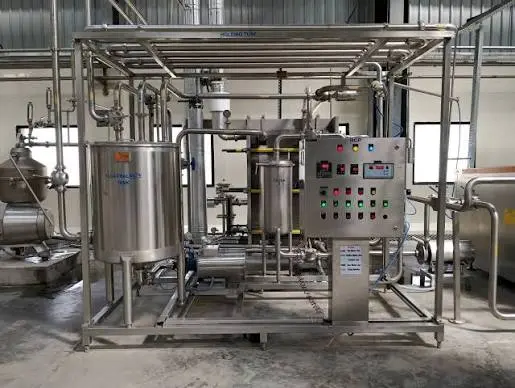
| Pasteurisation | HTST pasteuriser with PHE | Heat treatment for safety and shelf life |
| Post-processing | Chilled storage tank | Hold pasteurised milk before packing |
| Packing | Pouch filling machine | Fill and seal for distribution |
| Cleaning | CIP system | Clean-in-place, non-negotiable for hygiene compliance |
You can review configured systems on the milk processing plant and dairy plant pages, and storage options under milk storage silos.
Why the pasteuriser deserves the most attention
It is the single most important machine in the line, because it is what makes the product legally saleable and determines shelf life.
HTST, or High Temperature Short Time, holds milk at approximately 72 to 75 degrees Celsius for 15 to 20 seconds using a plate heat exchanger, then chills it rapidly. It is continuous, energy efficient through regeneration, and the standard for commercial liquid milk.
Batch pasteurisation heats a full vat at a lower temperature for around 30 minutes. Cheaper and simpler, suitable for very small volumes or speciality products, but slow and labour intensive at scale.
For any unit intending to sell packed liquid milk daily, HTST is the practical choice. Maxonova builds HTST pasteurisation systems at 500 LPH and 2500 LPH.
Questions to ask about any pasteuriser:
- What is the regeneration efficiency? Higher regeneration means lower steam and chilling cost every single day of operation.
- Is there automatic flow diversion if temperature drops below the set point?
- Is the holding tube correctly sized and certified for the rated flow?
- What is the temperature recording arrangement? You will need this for FSSAI inspection.
- Is the PHE gasketed for easy inspection, and are gaskets locally available?
Value-added lines, added later
Most successful small dairies start with liquid milk and add products once collection is stable. Value-added lines carry better margins but need their own equipment and their own market.
| Product | Equipment | Why add it |
| Ghee | Ghee making plant, available at 300 LPD and 500 LPD | Uses surplus cream, long shelf life, strong margins |
| Paneer | Paneer vat, press, chilling | High local demand, quick turnover |
| Ice cream | Ice cream plant, 100 to 1500 LPH | Seasonal peaks, premium pricing |
| Curd and buttermilk | Incubation and packing | Simple addition, uses the same base milk |
Sequence matters. Get liquid milk running reliably first. Adding a second product line while the first is still unstable is how small dairies end up with idle equipment and stretched working capital.
Step three: licensing and compliance
Getting this wrong delays commissioning, so establish it early.
Which FSSAI licence applies
| Daily handling capacity | Licence category | Indicative annual fee |
| Up to 500 litres per day | FSSAI Registration | Lowest tier |
| 501 to 50,000 litres per day | FSSAI State Licence | ₹2,000 to ₹5,000 |
| Above 50,000 litres per day | FSSAI Central Licence | ₹7,500 |
Milk solids have parallel thresholds, broadly 2.5 MT to 2,500 MT per annum for State Licence and above 2,500 MT for Central.
The practical takeaway: cross-reference this against the LPH conversion table above. A 2,500 LPH plant running twelve hours reaches 30,000 LPD, still comfortably inside State Licence territory. Almost every mini and small dairy plant in India needs a State Licence, not a Central one. If a consultant tells you otherwise for a plant under 50,000 LPD, ask them to show you the threshold.
Budget realistically for the licensing process overall, including documentation, plant layout approval, water and product testing and professional fees. Many operators report total costs well above the headline licence fee.
What else to arrange
- State pollution control board consent to establish and consent to operate
- Factory or trade licence from the local authority
- Water testing, since potable water quality is a compliance requirement
- Legal metrology registration for packaged quantity declarations
- GST registration
- Weights and measures verification for weighing equipment
- Product testing arrangements, either in-house lab or an accredited external lab
Rules vary by state and change over time. Confirm current requirements with your state food safety department and a licensing consultant before committing to a timeline. Our quality and compliance page sets out the standards our equipment is built to.
Step four: building, utilities and layout
Equipment arrives faster than most people prepare the site. This is the most common cause of delayed commissioning.
Space
A 500 LPD-scale processing unit can work within roughly 1,500 to 2,000 square feet. Plan for more as capacity rises, and remember that space is not just the machine footprint.
| Area | Purpose |
| Reception dock | Can unloading, weighing, scrubbing |
| Processing hall | The main line, with clearance for operation and maintenance |
| Cold room | Chilled storage of finished product |
| Packing area | Filling, sealing, crate handling |
| Utility room | Boiler, chiller, compressor, kept separate from processing |
| Laboratory | Fat, SNF and acidity testing |
| Store | Packaging material, chemicals, spares |
| Office and welfare | Records, staff changing, washrooms |
Design for milk flow in one direction. Raw milk should never cross the path of pasteurised milk. Inspectors look for this, and it prevents contamination.
Utilities to confirm before equipment arrives
- Power. Three-phase supply with adequate sanctioned load, plus a generator. A power cut mid-pasteurisation means dumping the batch.
- Steam. A boiler sized for the pasteuriser, with the fuel choice decided early since it affects running cost significantly.
- Chilled water. A chiller and ice bank, sized for peak load rather than average.
- Potable water. Adequate volume for processing and CIP, tested and documented.
- Effluent treatment. Dairy effluent has high organic load. Plan for treatment, since pollution board consent depends on it.
- Drainage. Sloped floors, trapped drains, food-grade epoxy or tiled surfaces.
Effluent is the item most often underestimated. Factor it into the budget and the layout from day one rather than discovering it during the consent process.
Step five: budgeting properly
Equipment is roughly half the project. Here is the fuller picture.
| Cost head | Share of project | Notes |
| Processing equipment | 45 to 55 percent | The core line |
| Civil work and building | 15 to 25 percent | More if constructing new |
| Utilities | 10 to 15 percent | Boiler, chiller, generator, compressor, ETP |
| Cold room | 5 to 10 percent | Sized to daily output |
| Licensing and professional fees | 2 to 5 percent | Licences, consultants, testing |
| Working capital | 10 to 20 percent | Three to six months of milk procurement |
Working capital is the line that catches people. Milk is paid for on short cycles, often within days, while receivables from distributors run longer. A plant with no working capital cushion stalls in month two despite having perfect equipment.
Funding routes worth investigating
Government support for dairy processing exists but scheme terms change. Rather than relying on figures in any article, take these to your bank and to NABARD directly:
- NABARD-linked capital subsidy schemes for dairy processing, historically offering back-ended capital subsidy at around 25 percent for general category and 33.33 percent for SC and ST applicants, subject to scheme status and eligibility.
- Animal Husbandry Infrastructure Development Fund, offering interest subvention on eligible dairy processing projects.
- PMFME, the scheme for micro food processing enterprises, offering credit-linked grant support.
- State dairy development schemes, which vary considerably and are often overlooked.
Confirm current scheme status, eligibility and application windows with your lending bank before building them into a project plan. Schemes open, close and change terms.
Step six: choosing a manufacturer
Equipment selection matters less than most buyers think. Manufacturer selection matters more.
What to verify
| Check | What good looks like |
| Steel grade in writing | SS 304 for contact surfaces, SS 316 where required, with material test certificates |
| Plants commissioned | Reference installations at your capacity you can visit or call |
| Sizing approach | They ask about your collection, shifts and products before quoting |
| Scope clarity | Written scope stating what is and is not included |
| Installation and commissioning | Included and defined, not a later surprise |
| Operator training | On-site training for your team, specified in the order |
| Spares availability | Gaskets, seals, valves available locally with stated lead times |
| After-sales response | A commitment on response time for breakdowns |
| Warranty | Duration and coverage stated clearly |
Red flags
- A quotation issued without asking your daily collection or shift pattern
- Steel grade described only as “food grade” with no 304 or 316 specification
- No material test certificates offered
- Installation and commissioning quoted separately after the order
- No reference installations at comparable capacity
- Pressure to order before your building and utilities are planned
- Vague answers about spares availability and lead times
Ask this question directly: what will it cost me to run this plant for a year, including steam, power, chilled water and CIP chemicals? A manufacturer who has actually commissioned plants can answer it. Running cost over ten years dwarfs the purchase price, and regeneration efficiency on the pasteuriser is where most of that difference sits.
A realistic project timeline
| Phase | Duration | Runs in parallel with |
| Feasibility, milk supply tie-up, site selection | 4 to 8 weeks | Licensing research |
| Capacity finalisation and manufacturer selection | 3 to 4 weeks | Loan application |
| Order placement and advance | 1 week | Building work starts |
| Manufacturing and fabrication | 8 to 12 weeks | Civil work, utilities, licence applications |
| Delivery and installation | 2 to 4 weeks | Staff recruitment |
| Commissioning and trial runs | 2 to 3 weeks | Operator training |
| Licence inspection and approval | 2 to 6 weeks | Trial production |
| Commercial production |
Three to five months from order to commissioning is realistic when the building and utilities progress in parallel. Sequential planning, where site work starts only after equipment arrives, typically adds two to three months.
Frequently asked questions
What is a mini dairy plant?
A mini dairy plant is a compact milk processing unit, broadly 100 to 1,000 litres per hour, covering milk reception, chilling, standardisation, pasteurisation, storage and packing. It suits a first processing venture, a farm-attached unit or a local milk brand, and can be expanded later with ghee, paneer or ice cream lines.
How much does it cost to set up a mini dairy plant in India?
Total project cost typically runs ₹40 lakh to ₹80 lakh at entry level, of which equipment accounts for roughly ₹25 lakh to ₹45 lakh at 500 LPH including installation and commissioning. A 2,000 LPH plant generally falls in the ₹1 crore to ₹2 crore range. Civil work, utilities, cold room, licensing and working capital make up the rest. Figures are indicative and vary with automation, product mix and location.
What is the difference between LPH and LPD?
LPH is litres per hour, the machine’s processing rate. LPD is litres per day, your business volume. A 500 LPH plant running an eight hour shift handles 4,000 LPD. Confusing the two is the most common sizing error in this market, and it leads to buying equipment several times larger or smaller than the business needs.
Which FSSAI licence does a dairy processing unit need?
Units handling 501 to 50,000 litres of milk per day require an FSSAI State Licence. A Central Licence applies only above 50,000 litres per day, or above 2,500 MT of milk solids per annum. Since even a 2,500 LPH plant on a twelve hour shift reaches only about 30,000 LPD, almost every mini and small dairy plant needs a State Licence rather than a Central one.
How much space is required for a small dairy plant?
Roughly 1,500 to 2,500 square feet for a small unit, covering the reception dock, processing hall, cold room, packing area, utility room, laboratory, stores and office. Layout should keep raw milk and pasteurised milk on separate paths, which inspectors specifically check.
What is HTST pasteurisation and why does it matter?
HTST, or High Temperature Short Time, holds milk at approximately 72 to 75 degrees Celsius for 15 to 20 seconds in a plate heat exchanger, then chills it rapidly. It is continuous, energy efficient through heat regeneration, and the practical standard for commercial packed liquid milk. Batch pasteurisation is cheaper but slow, and generally suits only very small volumes or speciality products.
Should equipment be SS 304 or SS 316?
SS 304 is standard for most milk contact surfaces and performs well across a dairy line. SS 316 contains molybdenum, giving better resistance where chloride, salt or acid exposure is higher, such as certain cheese and paneer applications or areas with aggressive cleaning chemistry. Get the grade specified in writing per component, and ask for material test certificates.
How long does it take to commission a mini dairy plant?
Three to five months from order placement, assuming building work, utility connections and licence applications run in parallel with equipment fabrication. Manufacturing typically takes eight to twelve weeks, installation two to four, commissioning and trials two to three, and licence inspection a further two to six.
Are government subsidies available for dairy processing plants?
Support exists through NABARD-linked capital subsidy schemes for dairy processing, the Animal Husbandry Infrastructure Development Fund, the PMFME scheme for micro food enterprises, and various state dairy development programmes. Terms, eligibility and scheme status change, so confirm current details with your lending bank and NABARD rather than relying on published figures.
What is the biggest mistake first-time dairy plant owners make?
Two, and they are linked. Sizing on the wrong unit, buying LPH capacity as though it were LPD, and underestimating working capital. Milk is paid for within days while receivables take longer, so a plant with three to six months of procurement cushion survives its first year and one without it does not, regardless of equipment quality.
Can a mini dairy plant be expanded later?
Yes, if it is planned for. Leave floor space for additional lines, size utilities such as the boiler and chiller with headroom, and confirm with your manufacturer that the layout permits adding ghee, paneer or ice cream equipment without relocating the core line. Retrofitting capacity into a tightly packed hall costs far more than allowing for it initially.
Do I need a CIP system in a small plant?
Yes. Clean-in-place is a hygiene requirement, not an optional upgrade. Manual cleaning of a closed milk line is neither reliable nor demonstrable to an inspector. Any quotation that omits CIP is incomplete.
Getting your plant sized correctly
The most useful next step is not comparing quotations. It is establishing your real capacity requirement, because every other number in the project follows from it.
Tell us your current daily milk collection, your expected volume in two years, how many hours you can realistically run, and which products you want to make. We will size the plant against those numbers and set out what the line needs, what the utilities need to support it, and what the scope of supply covers.
Request a quotation, call +91 99901 93331, or message us on WhatsApp with your capacity requirement.
You can also browse the full range of dairy and milk processing equipment, read more about Maxonova, or see what our clients say in the testimonials.
Maxonova Dairytech Private Limited manufactures dairy plants, milk processing systems, HTST pasteurisation plants, ice cream plants, ghee making plants, milk storage silos and can scrubber machines in food-grade SS 304 and SS 316. Manufacturing from Greater Noida, Uttar Pradesh since 2010.
Leave A Comment