
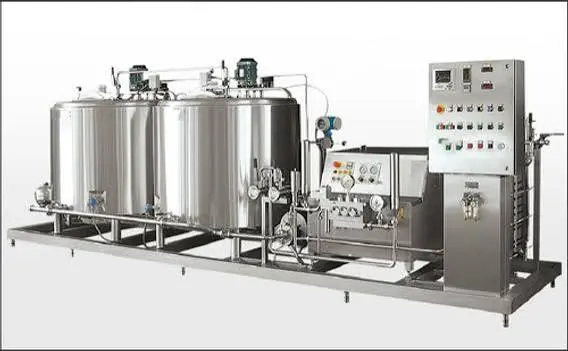
Choosing Dairy Processing Equipment That Passes FSSAI and Pays Back
Short answer: milk processing equipment is a connected line, not a list of machines. A working dairy unit needs chilling, storage, separation and standardisation, pasteurisation, homogenisation, and clean-in-place, sized to a single capacity figure in litres per hour. Get the capacity and the stainless steel grade right first, because every other decision follows from those two. For ghee and ice cream lines, the process parameters are set by FSSAI composition standards, not by preference.
This guide covers what to specify across dairy, milk processing, ghee and ice cream plants, and the checks that separate a plant that runs for fifteen years from one that fails its first inspection.
What a milk processing line actually contains
Buyers often request a quotation for “a milk processing plant” without a defined process flow. The result is a quotation that cannot be compared with any other. Here is the sequence every liquid milk line follows.
| Stage | Equipment | Purpose | Typical parameter |
| Reception | Milk can scrubber, weighing, dump tank | Receive and screen incoming milk | Rated in cans per hour |
| Chilling | Plate chiller or bulk milk cooler | Arrest bacterial growth | Bring to 4 °C |
| Storage | Insulated SS silo or tank | Hold before processing | Sized to one shift’s intake |
| Clarification | Clarifier or separator | Remove sediment, separate cream | Centrifugal |
| Standardisation | Cream separator, blending | Set fat and SNF to target | To FSSAI milk class |
| Pasteurisation | HTST plate heat exchanger | Kill pathogens | 72 °C for 15 seconds |
| Homogenisation | Two-stage homogeniser | Prevent cream separation | Roughly 150 to 200 bar |
| Cooling | Regeneration and chilled water section | Return to storage temperature | 4 °C |
| Packing | Pouch filling machine | Fill and seal | Rated in pouches per hour |
| Cleaning | CIP system | Sanitise the line daily | Caustic then acid cycle |
Two of these are commonly under-specified and cause the most trouble later: the CIP system and the chilling capacity. A line that cannot be cleaned in the available window between shifts will fail microbiological testing regardless of how good the pasteuriser is.
Sizing capacity: the number everything else depends on
Capacity is quoted in LPH (litres per hour) for continuous lines, LPD (litres per day) for batch products such as ghee, and CPH (cans per hour) for can washing.
The common mistake is sizing to today’s collection volume. The correct method is to size to your realistic volume in year three, then check whether the equipment can run economically at today’s volume.
| Your daily intake | Suggested line capacity | Typical fit |
| Up to 2,000 litres | 200 to 500 LPH | Mini dairy unit, local milk brand, FPO |
| 2,000 to 6,000 litres | 500 to 1,000 LPH | Growing regional dairy |
| 6,000 to 15,000 litres | 1,000 to 2,000 LPH | Established brand with multi-district collection |
| 15,000 litres and above | 2,500 LPH and above | Full commercial processing unit |
A useful cross-check: divide your target daily volume by the number of hours you can realistically run the line, allowing at least ninety minutes for CIP and changeover. If a 1,000 LPH line needs sixteen hours a day to clear your intake, you have bought the wrong size. See configured milk processing plants by rated capacity to compare against your own volume.
HTST pasteurisation: the parameters that matter
Pasteurisation is where food safety is either achieved or not, so this is the section to scrutinise in any quotation.
Time and temperature. High Temperature Short Time pasteurisation holds milk at 72 °C for 15 seconds. The holding tube must be physically long enough to guarantee that residence time at the rated flow. If a supplier cannot explain how the holding tube length relates to the rated LPH, that is a serious signal.
Flow diversion valve. If milk drops below the set temperature, an FDV must automatically divert it back to the balance tank rather than allowing it forward. This is not an optional automation upgrade. It is the mechanism that prevents under-pasteurised milk reaching your packing machine.
Regeneration efficiency. A plate heat exchanger uses outgoing hot milk to pre-heat incoming cold milk. Well-designed units typically recover 85 to 90 percent of the heat. This single specification has more effect on your running cost than almost anything else in the plant, because it directly reduces both steam and chilled water demand. Ask for the regeneration percentage in writing.
Verification. The alkaline phosphatase test confirms that pasteurisation was adequate. A negative phosphatase result is the standard evidence that the process worked. Build this into your daily quality routine from day one, not after your first inspection.
Batch alternative. LTLT or batch pasteurisation holds milk at 63 °C for 30 minutes. It suits very small volumes and speciality products but scales poorly, because throughput is limited by vessel size and cycle time.
SS 304 or SS 316: where the extra cost is justified
Both are food-grade austenitic stainless steels. The difference is molybdenum, which gives 316 better resistance to chlorides and acids.
| Application | Recommended grade | Reason |
| Milk contact surfaces, tanks, silos | SS 304 | Adequate for neutral pH milk, sound economics |
| Plate heat exchanger plates | SS 316 | Repeated acid CIP cycles and chloride exposure |
| Brine and chilled water circuits | SS 316 | Chloride attack risk |
| Ghee kettles and high-temperature vessels | SS 304 or 316 by design | Depends on cleaning chemistry |
| Structural frames, non-contact parts | SS 304 | No product contact |
Two points buyers miss. First, surface finish matters as much as grade: product contact surfaces need a smooth polished finish, because a rough surface harbours bacteria that CIP cannot reach. Second, insist on material test certificates. “Food grade stainless” on a quotation without a grade and a certificate is not a specification, and grade substitution is the most common way a suspiciously cheap quotation is achieved.
Ghee making plants: the process is set by the standard
FSSAI defines ghee as containing a minimum of 99.7 percent milk fat with moisture not exceeding 0.3 percent. Those two figures determine your entire process design, because the plant exists to remove water and non-fat solids from butter or cream.
Process sequence. Cream or butter is melted in a steam-jacketed kettle, then boiled to drive off moisture. Temperature is raised progressively so that residual moisture evaporates and the characteristic ghee flavour develops through browning of the milk solids. The ghee residue is then separated, and the clarified fat is settled, filtered and packed warm.
What to specify.
- Steam-jacketed kettle with controlled heating rather than direct flame, for consistent flavour and no localised scorching
- Agitator sized to the vessel, to prevent solids settling and burning on the base
- Temperature control and indication, since flavour development and moisture removal both depend on the heating curve
- Ghee residue separation and filtration arrangement
- Settling tank and warm packing arrangement
Quality parameters to test. Beyond fat and moisture, Indian ghee quality is verified through the Butyro-refractometer reading, Reichert Meissl value, Polenske value, free fatty acids and the Baudouin test for adulteration. Set up access to a testing laboratory before commissioning, not after. Capacity for these lines is rated in litres per day, and the ghee making plants range is specified on that basis.
Ice cream plants: overrun is where the economics live
FSSAI requires ice cream to contain a minimum of 10 percent milk fat, along with minimum solids-not-fat and total solids limits. Your mix formulation must meet that floor before any equipment discussion begins.
Process sequence. Ingredients are blended in a mix tank, pasteurised, homogenised, then aged at around 4 °C for several hours. Ageing is the step small operators skip and then wonder why texture is poor: it allows fat crystallisation and protein hydration, and it materially improves the final product. The aged mix passes through a continuous freezer, is filled, then hardened at a much lower temperature before cold storage.
Overrun. This is the volume of air incorporated into the mix, and it is the single most important commercial parameter in ice cream. Higher overrun yields more litres from the same mix and lowers cost per litre, but reduces richness and perceived quality. Premium products run low overrun; economy products run high. Your continuous freezer must be able to hold your chosen overrun consistently, because variation shows up immediately as inconsistent pack weights.
What to specify.
- Mix pasteurisation and homogenisation appropriate to your fat content
- Ageing vat sized for your daily batch, with refrigeration
- Continuous freezer with controllable and repeatable overrun
- Hardening tunnel or blast freezer, then cold storage
- Filling equipment matched to your pack format, whether cups, cones, bars or tubs
Capacity here is rated in LPH of mix. Configurations across the ice cream plants range span small artisan output through to commercial lines.
How to evaluate a dairy equipment manufacturer
Apply these before requesting a quotation, so you can compare like with like.
- Manufacturer or trader. Ask for the factory address and whether fabrication happens in-house. A trader cannot control weld quality or honour a fabrication warranty.
- Material test certificates. For every stainless steel item, by grade.
- Weld quality and finish. Product contact welds should be smooth and polished, not ground and left rough. Ask for photographs of completed vessels, not renders.
- A named process flow diagram for your plant. Not a generic catalogue diagram. If the supplier cannot draw your line, they have not understood your requirement.
- Utility load schedule. Steam, power, water and chilled water demand per hour, in writing. You need this before you size your boiler and transformer.
- Installation and commissioning scope. Clarify in writing what is supplied, what is erected, and what you must arrange, including foundations, piping and electricals.
- Operator training and documentation. Manuals, CIP procedures and a trained operator on handover.
- Spares and service response. Ask which spares are held in stock and what the response time is for a breakdown. A dairy plant down for four days is spoiled milk and lost customers.
- Reference installations. Ask to speak to an operating client with a comparable capacity.
Site and utility readiness
These are the items that delay commissioning far more often than equipment delivery.
- Steam. Confirm your boiler capacity against the supplier’s steam load figure. In India, boiler selection also carries a statutory dimension: larger boilers fall under the Indian Boilers Regulation and require registration and periodic inspection, while small steam generators are often designed to sit below that threshold. Confirm the applicable requirement with your boiler supplier and the state boiler inspectorate before ordering.
- Power. Three-phase supply with adequate sanctioned load, plus backup. Compressor and homogeniser starting loads are significant.
- Water. Potable water meeting drinking standards for product contact and final rinse. Hard water causes scaling in the heat exchanger and shortens plate life.
- Drainage. Correctly sloped floor drains. Dairy floors are washed constantly, and standing water is both a hygiene failure and a safety hazard.
- Effluent. Dairy effluent carries a high organic load. Confirm your effluent treatment obligation and consent to operate with the State Pollution Control Board before construction, not after.
- Licensing. FSSAI licence at the correct tier for your capacity, plus applicable state registrations. Apply early, as the timeline often exceeds equipment lead time.
Six mistakes that cost the most
- Sizing to today’s volume. Replacing an undersized pasteuriser in year two costs far more than buying correctly once.
- Comparing quotations on price rather than scope. A cheaper quotation usually omits CIP, controls, installation or a stainless steel grade.
- Underspecifying CIP. Manual cleaning does not reach heat exchanger plates. This is where microbiological failures begin.
- Ignoring regeneration efficiency. A low-regeneration pasteuriser costs more in steam and power every single day it operates.
- Leaving utilities until after the order. Equipment arrives, the boiler is undersized, and commissioning stalls for weeks.
- No trained operator. The plant is only as reliable as the person running the CIP cycle at the end of a long shift.
Frequently asked questions
What equipment is needed to start a small dairy processing unit?
At minimum: a milk can scrubber and reception arrangement, a chiller to bring milk to 4 °C, an insulated storage tank, an HTST pasteurisation unit, a cream separator if you are standardising fat, a pouch filling machine, and a CIP system. A cream separator and homogeniser can be added later, but chilling, pasteurisation and CIP cannot.
What temperature and time is used for milk pasteurisation?
HTST pasteurisation holds milk at 72 °C for 15 seconds before cooling to 4 °C. Batch or LTLT pasteurisation holds milk at 63 °C for 30 minutes. Adequate pasteurisation is verified using the alkaline phosphatase test, which should return a negative result.
Should dairy equipment be SS 304 or SS 316?
SS 304 is suitable for most milk contact surfaces, tanks and silos. SS 316 is preferred where chlorides or acids are present, such as plate heat exchanger plates and brine circuits, because its molybdenum content resists that attack. Always ask for material test certificates rather than accepting a general claim of food-grade steel.
What are the FSSAI requirements for ghee?
FSSAI requires ghee to contain a minimum of 99.7 percent milk fat with moisture not exceeding 0.3 percent, and prohibits artificial colours, flavours and preservatives. Quality is further verified through the Butyro-refractometer reading, Reichert Meissl value, Polenske value, free fatty acids and the Baudouin adulteration test.
What is overrun in an ice cream plant?
Overrun is the proportion of air incorporated into the ice cream mix during freezing. It determines yield and texture: higher overrun produces more litres per batch at lower cost but lighter body, while lower overrun produces a denser, richer product. Consistent overrun control is what keeps pack weights uniform.
How much space does a mini dairy plant need?
Space depends on capacity and layout, but plan for separate zones for reception, processing, packing and storage, with clear personnel and material flow that does not cross raw and pasteurised areas. Your supplier should provide a layout drawing with utility positions before civil work begins.
How long does installation and commissioning take?
Equipment manufacturing lead time and site readiness usually run in parallel. Delays are far more often caused by incomplete civil work, insufficient boiler capacity or pending licences than by equipment supply. Confirm the utility load schedule at the order stage so that site preparation finishes before delivery.
Get your line specified before you compare prices
Three numbers make a quotation meaningful: your daily intake volume, your realistic operating hours per day, and your product mix across liquid milk, ghee, paneer and ice cream. Without those, every quotation you receive will describe a different plant.
Request a plant specification with your capacity requirement, product range and site location, and receive a process flow with a utility load schedule rather than a generic price list.
Maxonova Dairytech Private Limited has manufactured dairy and food processing equipment since 2010 from Greater Noida, Gautam Buddha Nagar, supplying dairy plants, milk processing and HTST pasteurisation systems, ghee making plants, ice cream plants, milk storage silos and can scrubber machines in SS 304 and SS 316. Composition figures cited reflect FSSAI standards for milk and milk products and should be verified against the current regulation applicable to your product.
Leave A Comment