
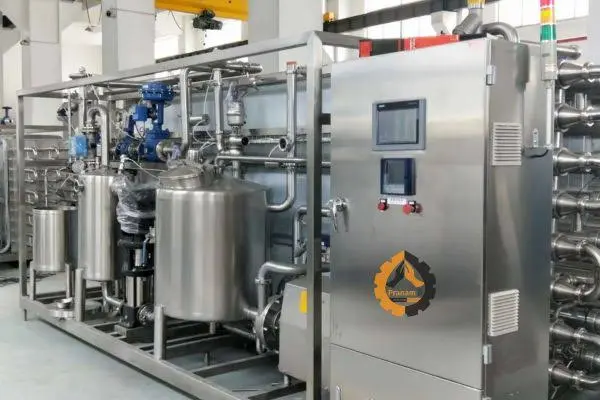
How to Size a Milk Processing Plant: What 500, 1000, 2000 and 2500 LPH Actually Deliver
Short answer: LPH means litres per hour through the pasteurizer, not litres per day. A 1000 LPH plant does not process 24,000 litres a day. After startup, changeover and cleaning in place, a single shift realistically delivers around six productive hours, so plan on roughly 6,000 litres a day from a 1000 LPH line and scale from there. Size the plant to your milk procurement over the next three years, then check that chilling, storage and packing can keep up with the pasteurizer, because the pasteurizer is almost never the bottleneck in a plant that underperforms.
Most underperforming dairy projects in India were not sold the wrong pasteurizer. They were sold a correctly sized pasteurizer with undersized chilling, too little storage, and a pouch filling machine that cannot clear the batch before quality starts to slip. This guide covers how to avoid that.
LPH to daily output: the number that matters
Rated capacity assumes continuous flow with product available and no interruption. Real plants lose time to warm up, water flush, product changeover and cleaning in place. Use effective hours, not clock hours.
| Rated capacity | Rated output over 8 clock hours | Realistic single shift output | Realistic two shift output | Typical suitable procurement |
| 500 LPH | 4,000 litres | 2,500 to 3,000 litres | 5,500 to 6,500 litres | Village level unit, single FPO, local brand launch |
| 1000 LPH | 8,000 litres | 5,500 to 6,500 litres | 12,000 to 14,000 litres | District brand, small private dairy, hotel and institutional supply |
| 2000 LPH | 16,000 litres | 11,000 to 13,000 litres | 24,000 to 28,000 litres | Multi route procurement, established regional brand |
| 2500 LPH | 20,000 litres | 14,000 to 16,000 litres | 30,000 to 35,000 litres | Cooperative union, large private dairy, contract processing |
The figures above assume one product stream. Every additional product on the same line costs another changeover and another clean, which is why plants making pouch milk plus curd plus paneer on one pasteurizer hit their ceiling far earlier than the datasheet suggests.
A sizing rule that holds up in practice: choose the capacity that handles your projected peak flush season procurement in a single shift, not your annual average in two shifts. Flush and lean season volumes in most Indian catchments differ substantially, and a plant sized on the average will either spoil milk in flush or run inefficiently in lean.
What a milk processing plant contains
A complete plant is a set of interdependent systems. The pasteurizer gets the attention and the other five decide whether it performs.
| Function | Core dairy manufacturing equipment | Why it constrains capacity |
| Reception and testing | Weighing or flow metering, dump tank, milk analyzer for fat and SNF, strainer or filter | Slow reception delays the whole day and raises acidity risk in warm months |
| Chilling | Plate chiller, ice bank tank or chilling unit, chilled water circulation | The most commonly undersized system. If milk cannot reach 4 degrees Celsius fast, nothing downstream can fix the quality |
| Storage | Insulated silos or milk storage tanks, raw and pasteurized separately | Too little storage forces the pasteurizer to wait for tankers or the packing line |
| Processing | HTST pasteurizer with plate heat exchanger and holding tube, cream separator, homogenizer, standardization | Regeneration efficiency in the plate heat exchanger drives your steam and chilling load |
| Packing | Pouch filling machine, crate handling, coding, cold room | Frequently the true bottleneck. Pasteurized milk waiting to be packed is a quality and shelf life problem |
| Utilities | Steam boiler, refrigeration, air compressor, soft water plant, power backup | Utility shortfalls appear as intermittent capacity loss that looks like equipment failure |
| Cleaning | CIP system with acid and alkali tanks, dosing, return pumps | Manual cleaning at these capacities is slow, inconsistent and a food safety exposure |
| Effluent | Effluent treatment plant sized to water use | Regulatory requirement and a common cause of delayed commissioning |
Two systems deserve emphasis because they cause the most disappointment after commissioning.
Chilling is where plants quietly fail. Milk quality is decided in the first hour after reception. If ambient temperature is high, the catchment is dispersed, and the chilling capacity is matched only to the pasteurizer rating rather than to the reception peak, acidity rises before processing even starts. Specify chilling against how fast milk actually arrives, not against the pasteurizer flow rate.
Packing capacity must exceed processing capacity. Pasteurized milk should move to pouch and into the cold room without sitting in a tank. A pouch machine rated below the pasteurizer output means either the pasteurizer runs at partial capacity or the milk waits, and waiting warm pasteurized milk is the shortest route to customer complaints about shelf life. The full range of dairy manufacturing equipment should be specified as a matched set for this reason, rather than assembled from separately sourced units at different capacities.
Utilities, space and power: the costs that surprise buyers
These are the line items most first time dairy entrepreneurs leave out of the project report, and together they can add materially to the total.
| Requirement | 500 LPH | 1000 LPH | 2000 LPH | 2500 LPH |
| Indicative built up area | 1,500 to 2,500 sq ft | 2,500 to 4,000 sq ft | 4,000 to 6,000 sq ft | 5,000 to 8,000 sq ft |
| Indicative connected load | 15 to 30 kW | 30 to 50 kW | 50 to 80 kW | 70 to 110 kW |
| Steam requirement | Small package boiler | Package boiler | Package boiler with reserve | Package boiler with reserve |
| Water requirement | Roughly 1.5 to 3 litres per litre of milk processed, depending on CIP design and reuse | |||
| Cold room | Sized to at least one full day of finished goods, more if distribution is alternate day | |||
| Effluent treatment | Required, sized to water consumption, plan approvals early |
All figures are indicative for early stage budgeting and vary with automation level, product mix, building layout and local conditions.
Two practical notes. Water consumption per litre of milk processed is a real operating cost and a regulatory factor, and a well designed CIP with water recovery meaningfully reduces both the water bill and the effluent load. And on power, a dairy cannot tolerate interruption mid batch, so backup generation sized for the refrigeration and processing load is not optional in most Indian locations.
Compliance: what applies at these capacities
Regulatory requirements should be confirmed against current rules, but the framework for a dairy in India generally involves the following.
- FSSAI licence. Units handling more than 500 litres of liquid milk per day, and up to 50,000 litres per day, generally fall under a State FSSAI licence, with a Central licence applying above that threshold. Every capacity discussed here sits inside the State licence band, but confirm current thresholds before applying, as they are periodically revised.
- Product standards. Pasteurized milk must meet the prescribed fat and SNF minima for the class of milk being sold, so your standardization and testing setup has to be capable of hitting and proving those figures consistently. Indicative FSSAI classes are set out below.
- Legal metrology. Packaged declarations, net quantity, manufacturer details and date marking are governed by packaged commodity rules, and pouch printing has to comply from day one.
- Pollution control consent. Consent to establish and consent to operate from the State Pollution Control Board, which is why effluent treatment must be in the plan and not an afterthought.
- Factory and local approvals. Building plan approval, fire clearance, and where applicable factory registration and boiler registration under the Boilers Act.
| Milk class | Minimum fat | Minimum SNF |
| Full cream milk | 6.0 percent | 9.0 percent |
| Standardised milk | 4.5 percent | 8.5 percent |
| Toned milk | 3.0 percent | 8.5 percent |
| Double toned milk | 1.5 percent | 9.0 percent |
| Skimmed milk | not more than 0.5 percent | 8.7 percent |
These are indicative of the current framework and should be verified against the latest FSSAI standards before finalizing your product declarations.
The margin question: why product mix should drive capacity
This is the part of the decision most project reports get backwards. They size the plant for liquid milk volume and treat value added products as a later addition. In practice the economics run the other way.
Liquid pouch milk is a volume business with thin margins, and it competes with cooperatives that have scale advantages you will not match early. Value added products carry substantially better realization per litre of milk input, and they use capacity you have already paid for.
| Product | Relative margin | Additional equipment typically needed |
| Pouch milk | Lowest, volume driven | Pouch filling machine, crates, cold chain |
| Curd and dahi | Moderate to good | Incubation room, cup or pouch filling, blast cooling |
| Paneer | Good | Paneer vat or press, hoops, chilling tank, vacuum packing |
| Ghee | Good, long shelf life | Butter churn or cream separator route, ghee kettle, filling |
| Flavoured milk | Good, brand driven | Mixing tank, bottle or pouch filling, retort or sterilization depending on shelf life target |
| Buttermilk and lassi | Moderate | Mixing and blending tank, filling |
| Khoa and sweets | High, labour intensive | Khoa making machine, cold storage |
The practical implication for sizing: if a meaningful share of your milk will go to paneer, curd and ghee within two years, that changes your storage tank count, your CIP design, your cold room size and your labour plan more than it changes the pasteurizer rating. Decide the product roadmap before you finalize the layout, because retrofitting a curd incubation room into a building designed only for pouch milk is expensive and disruptive. Reviewing commissioned plant configurations with similar product mixes is a faster way to pressure test your own layout than starting from a blank drawing.
Indicative project cost
Costs vary widely with automation level, degree of stainless steel specification, product mix and how much civil work is included. The ranges below are indicative equipment cost for budgeting only and exclude land, building, effluent treatment and working capital.
| Capacity | Indicative equipment cost | Typical inclusions at this level |
| 500 LPH | Rs. 20 lakh to Rs. 45 lakh | Pasteurizer, chilling, storage tanks, CIP, basic pouch filling, semi automatic operation |
| 1000 LPH | Rs. 40 lakh to Rs. 85 lakh | Above with higher automation, cream separator, homogenizer, larger cold room |
| 2000 LPH | Rs. 80 lakh to Rs. 1.6 crore | PLC control, multiple storage silos, higher speed packing, value added product lines |
| 2500 LPH | Rs. 1 crore to Rs. 2 crore plus | Fuller automation, redundancy in utilities, multiple product streams |
Budget separately for civil work and building, effluent treatment, power backup, cold chain vehicles, initial working capital for milk procurement, and two to three months of operating expenses before collections stabilize. Working capital for procurement is the item most commonly underestimated, because you pay farmers on a short cycle and collect from distributors on a longer one.
Subsidy and financing routes are worth investigating before finalizing capital structure, since dairy processing has historically attracted support under central and state schemes, with eligibility varying by applicant type such as individual entrepreneur, FPO, cooperative or self help group. Confirm current scheme terms with the implementing agency, as they change periodically.
Six mistakes that hold plants below capacity
- Sizing chilling to the pasteurizer instead of to reception. Milk arrives in peaks. Chilling must handle the peak, not the average.
- Under-specifying the packing line. If the pouch machine cannot clear the batch, the pasteurizer rating is decorative.
- Too few storage tanks. Separate raw and pasteurized storage, with enough volume to decouple reception, processing and packing, is what allows any of the three to run at rated speed.
- Manual cleaning at scale. Beyond about 1000 LPH, manual cleaning is slow, inconsistent and a real food safety exposure. CIP is not a luxury item.
- Treating effluent and consents as post commissioning tasks. These are approval dependencies, and plants have sat idle waiting for them.
- Buying equipment from multiple suppliers without a single capacity match. A 2000 LPH pasteurizer, 1200 LPH chilling and a 1000 LPH filler is a 1000 LPH plant that cost 2000 LPH money.
What to measure once running
- Capacity utilization against realistic effective hours, not rated hours
- Milk loss percentage from reception to packed product, which is the single most revealing operational metric in a dairy
- Fat and SNF recovery against procurement, which catches both standardization drift and shrinkage
- Energy cost per litre processed and water consumed per litre processed
- Cleaning downtime per shift, which is where most recoverable capacity sits
- Returns and complaints as a share of dispatch, which is your early warning on cold chain performance
Frequently asked questions
What does LPH mean in a milk processing plant?
LPH means litres per hour through the pasteurizer at rated continuous flow. It is not daily capacity. Daily output depends on effective productive hours after startup, changeover and cleaning, which is typically around six hours in a single shift.
How much milk can a 1000 LPH plant process per day?
Around 5,500 to 6,500 litres in a realistic single shift, and 12,000 to 14,000 litres across two shifts. Running multiple products on the same line reduces these figures because each changeover requires cleaning.
Which capacity should a new dairy start with?
Match the capacity to your projected peak season procurement in a single shift over the next three years. Most first time private dairies with secured procurement start at 1000 or 2000 LPH, while village level units and FPOs commonly begin at 500 LPH and add capacity once procurement is proven.
What is the cost of a 500 LPH milk processing plant in India?
Indicatively Rs. 20 lakh to Rs. 45 lakh for equipment, depending on automation level, product mix and packing speed. Land, building, effluent treatment, power backup and working capital are additional and often equal a significant share of the equipment cost.
What equipment is essential in a small dairy plant?
Milk reception with testing, a plate chiller with chilling unit, insulated storage tanks for raw and pasteurized milk, an HTST pasteurizer, a cream separator and homogenizer where the product mix requires them, a CIP system, a pouch filling machine, a cold room, and utilities covering steam, refrigeration and soft water.
Do I need an FSSAI licence for a milk processing plant?
Yes. Units handling more than 500 litres of liquid milk per day generally require a State FSSAI licence, with a Central licence applying above 50,000 litres per day. Confirm current thresholds when applying, and factor pollution control consent and legal metrology compliance into the same timeline.
Should I make paneer and curd from the start?
If procurement is secure, yes, at least one value added product. Realization per litre on paneer, curd and ghee is materially better than on pouch milk, and the equipment addition is modest compared with the margin difference. What matters is designing the building and CIP for it from the start rather than retrofitting later.
How long does it take to commission a dairy plant?
For plants in this range, typically four to eight months from order to commercial production, with regulatory consents and civil work usually determining the timeline rather than equipment manufacture. Starting the approval process in parallel with fabrication is what compresses it.
Next step
Capacity selection is a procurement question before it is an equipment question. If you know your expected daily collection in flush and lean season, how the milk arrives, and which products you intend to sell in year two, a suitable configuration can be worked out quickly. Bring those three answers and request a plant configuration and cost estimate, or review the available plant capacities to see how the equipment sets differ between capacity bands.
Prepared by the Maxonova engineering team from dairy plant installations across India. Cost, space and utility figures are indicative for budgeting and vary by site, automation level and product mix. Regulatory thresholds and product standards should be verified against current FSSAI and state requirements.
Leave A Comment